

Fall Race Season: How to Prevent Running Injury and Pain
Fall is prime racing weather – cool, crisp mornings, big goal races on the calendar, and a city full of runners suddenly very motivated. It’s also the season when a lot of training plans quietly fall apart, not because of bad luck, but because of the most common mistake in running: doing too much, too soon.
If you want to reach the start line healthy, the work to prevent running injury starts now – well before race day.
The Most Common Types of Running Injuries
With a race looming, it’s tempting to cram. You realize the event is six weeks out, panic a little, and pile on mileage to make up for lost time. Your cardiovascular system adapts quickly, but tendons, bones, and connective tissue adapt much more slowly. That mismatch is exactly where overuse injuries live.
The usual suspects we treat every fall:
- Shin splints – often the first sign your mileage climbed faster than your legs could handle.
- IT band pain – that sharp outer-knee ache that shows up a few kilometres in.
- Runner’s knee (patellofemoral pain) – common when strength hasn’t kept pace with volume.
- Achilles tendon and plantar fascia irritation – frequently tied to a sudden change in pace, hills, or footwear.
How to Prevent Running Injury This Season
Most running injuries are load-management problems in disguise. A few habits go a long way:
- Progress gradually – The old rule of thumb: increasing weekly mileage by roughly 10% isn’t gospel, but the principle is sound: change one thing at a time and give your body time to catch up.
- Strength train – Two short sessions a week focused on hips, glutes, and calves do more to prevent injury than any amount of foam rolling.
- Respect recovery – Easy days should be genuinely easy, and sleep does more repair work than any gadget.
- Check your footwear – Shoes past their mileage, or a brand-new pair introduced right before a race, are both quiet troublemakers.
- Listen to the early signals – Pain that changes your stride is a stop sign, not something to run through.
What to Expect at a Sports Therapy Clinic Like Riverside Sports Therapy
Reading about your injury is a good start, but figuring out why it happened and how to fix it for good is where a clinic comes in. If you’ve never been to a sports therapy clinic before, here’s what the process actually looks like.
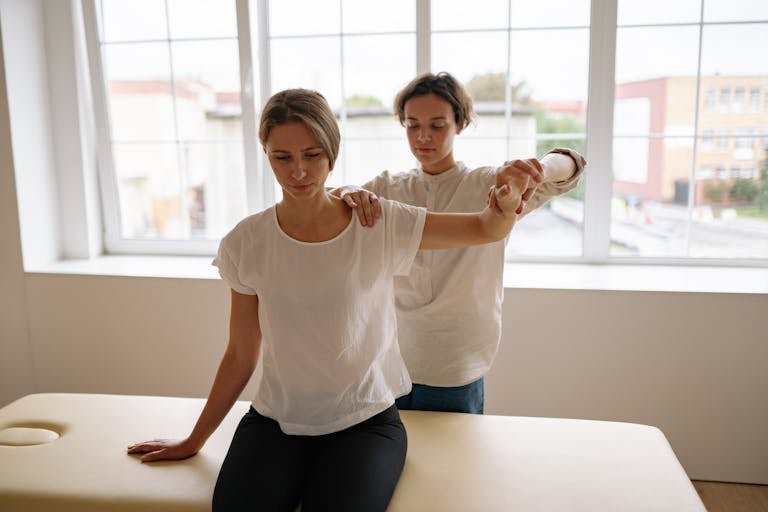
It starts with an assessment, not a quick fix. Rather than treating the sore spot in isolation, the team looks at the whole picture: your training history, how you move, and where the real problem is coming from. A lot of running injuries are symptoms of something further up the chain, whether it’s a weak hip driving knee pain, or a mobility restriction changing how your foot lands.
From there, treatment is tailored to the injury and the runner. Depending on what’s going on, that might include:
- Manual and soft tissue therapy to release tight, overworked muscles and restore movement.
- Dry needling or IMS for stubborn muscle tension and trigger points.
- Shockwave therapy for persistent issues like plantar fasciitis and Achilles tendinopathy.
- Targeted strengthening and rehab exercises to fix the imbalances that caused the injury in the first place.
- Load management and gait retraining so you build back up without overloading the same tissue again.
Just as important is the return-to-run plan. Coming back too fast is one of the most common reasons a running injury lingers or recurs. A good clinic maps out a gradual, structured return so you’re building strength and mileage safely.
And because Riverside Sports Therapy brings physiotherapy, chiropractic care, and massage therapy together under one roof, your assessment, treatment, and return-to-sport plan all connect.
When to Get Assessed
If something’s already grumbling – a shin that aches after every run, a knee that flares at the same distance – that’s the moment to get it looked at, not after the race when it’s become a bigger problem. A running assessment can pinpoint the strength or mechanics gap driving the issue and get you a plan to train around it. Catching it early is often the difference between a minor adjustment and a DNS.
Got a fall race on the calendar? Book an assessment and let’s get you to the start line ready to run – and to the finish line in one piece.



One Comment