Countdown to Ski Season: 14 Exercises for Skiing to Start Today
The best exercises for skiing build leg strength, balance, power and mobility in the weeks before your first run. Most skiers spend months off the hill, then ask their legs to handle a full day of turns, moguls and icy patches on opening weekend. That gap is where sore quads, tweaked knees and early-season injuries come from.
At Riverside Sports Therapy, our team has supported skiers at every level, from weekend warriors heading to Sunshine Village and Nakiska to athletes on the international freestyle circuit. This guide covers the exercises we recommend most, why each one matters, and a simple six-week plan you can start today.
Whether you ski groomers once a month or chase powder every weekend, a little preparation now means more good days on the hill and fewer days on the couch with an ice pack.
Why Skiing Demands Its Own Kind of Training
Skiing asks your body to do things few other activities do, often for hours at a time. General fitness helps, but ski-specific training targets the exact demands of the sport.
- Sustained, bent-knee loading – Holding an athletic stance means your quads, glutes and hips work continuously, often for several minutes per run. That builds fatigue fast, and tired muscles protect your joints less well.
- Eccentric strength – Much of skiing involves controlling force as muscles lengthen, such as absorbing bumps or resisting the pull of a turn. Eccentric strength is what keeps your legs from “burning out” mid-run.
- Single-leg control – Every turn shifts weight from one leg to the other. Weakness or poor control on one side can let the knee collapse inward, a common setup for knee sprains.
- Reactive balance – Snow conditions change constantly. Your ankles, hips and core need to make quick corrections without you thinking about it.
- Rotation and core stability – Your upper body stays quiet while your legs turn beneath you. A strong, stable trunk makes that separation possible and protects your lower back.
The exercises below are organized around these demands, so every movement you do has a clear reason to be in your program.
Strength Exercises for Skiing
Strength is the foundation of every other quality on this list. Start with bodyweight, focus on clean form, and add load once each movement feels controlled. Aim for 2 to 3 strength sessions per week.
1. Wall Sit
The wall sit mimics the isometric hold of a ski stance. Lean your back against a wall, slide down until your knees are bent to about 90 degrees, and keep your knees in line with your second toe. Hold for 30 to 60 seconds and build up gradually.
Why it helps: It trains your quads to tolerate long, burning holds, which is exactly what a long groomer asks of them.
2. Goblet Squat
Hold a dumbbell or kettlebell at your chest, feet about shoulder-width apart. Sit your hips back and down, keeping your chest tall and knees tracking over your toes. Drive through your whole foot to stand. Do 3 sets of 8 to 12.
Why it helps: Squats build the quad and glute strength that powers your turns and supports your knees.
3. Bulgarian Split Squat
Stand a stride’s length in front of a bench and rest the top of your back foot on it. Lower until your front thigh is close to parallel, then push back up through your front heel. Do 3 sets of 8 per leg.
Why it helps: It builds single-leg strength and exposes left-right imbalances, which matter because skiing loads one leg at a time.
4. Single-Leg Romanian Deadlift
Stand on one leg with a slight bend in the knee. Hinge at the hips, reaching your hands toward the floor while your free leg extends behind you. Keep your hips level, then return to standing. Do 3 sets of 8 per leg.
Why it helps: Strong hamstrings work alongside your quads to stabilize the knee, and this move builds balance at the same time.
5. Nordic Hamstring Curl (or Assisted Version)
Kneel with your ankles anchored under a heavy object or held by a partner. Slowly lower your body forward, resisting with your hamstrings, and catch yourself with your hands. Start with 2 sets of 4 to 6 and progress slowly, as this one is demanding.
Why it helps: Eccentric hamstring strength is one of the better-supported tools for protecting the knee, including the ACL.
6. Lateral Lunge
Step wide to one side, sit your hips back over that foot and keep the other leg straight. Push off to return to the centre. Do 3 sets of 8 per side.
Why it helps: Skiing happens in all directions. Lateral lunges strengthen the inner thighs and hips in the side-to-side plane that turns demand.
7. Copenhagen Plank
Lie on your side with your top leg resting on a bench and your bottom leg hanging free. Lift your hips into a side plank, supported by your forearm and top leg. Start with the knee on the bench and hold for 15 to 20 seconds per side.
Why it helps: It targets the adductors (inner thigh), which help control your knees and stabilize your stance through edge changes.
Power and Agility Exercises for Skiing
Once you have a base of strength, power work teaches your muscles to react quickly. Add these after two to three weeks of strength training, and always focus on soft, controlled landings.
8. Lateral Skater Hops
Leap sideways from one foot to the other, landing softly on the outside leg with a bent knee and hips back. Pause briefly to stick each landing before you progress to continuous hops. Do 3 sets of 10 per side.
Why it helps: It mirrors the side-to-side weight transfer of carving and trains your knee to stay stable when you land on one leg.
9. Squat Jumps
From a squat position, jump straight up, then land softly back into the squat. Reset between reps at first. Do 3 sets of 6 to 8.
Why it helps: It builds explosive leg power and trains you to absorb impact, which is useful for bumps, jumps and variable terrain.
10. Lateral Box Step-Overs or Line Hops
Stand beside a low step or a line on the floor. Hop quickly side to side over it with feet together, keeping your upper body quiet and facing forward. Work in 20 to 30 second bursts.
Why it helps: Quick feet and a stable upper body are the same skills you use linking short turns or skiing moguls.
Balance, Core and Mobility Exercises for Skiing
Strength and power get you down the hill. Balance, core control and mobility help you stay upright, recover from mistakes and move freely in your boots.
11. Single-Leg Balance With Reach
Stand on one leg with a soft knee. Reach your free foot forward, to the side and behind you, tapping lightly each time without losing balance. Do 3 rounds of 30 seconds per leg. To progress, stand on a cushion or close your eyes.
Why it helps: It builds the ankle and hip control that keeps you balanced on uneven snow and when your skis catch an edge.
12. Pallof Press
Anchor a resistance band at chest height and stand side-on to it. Hold the band at your chest, then press it straight out and resist the pull to rotate. Do 3 sets of 10 per side.
Why it helps: Skiers need a trunk that resists rotation while the legs turn underneath. This is anti-rotation core training at its simplest.
13. Side Plank With Hip Lift
Hold a side plank on your forearm, then lower and lift your hips in a slow, controlled motion. Do 2 to 3 sets of 10 per side.
Why it helps: It strengthens the obliques and the glute muscles on the side of the hip, both of which help keep your knees from collapsing inward.
14. Mobility Trio: Hip Flexors, Ankles and Upper Back
Spend 5 to 10 minutes on mobility after each session:
- Half-kneeling hip flexor stretch – 30 to 45 seconds per side to offset hours of sitting and bent-hip skiing.
- Knee-to-wall ankle mobility – 10 slow reps per side. Ski boots hold your ankle in a forward flex, and limited ankle range can push extra stress to the knees and hips.
- Open-book thoracic rotation – 8 to 10 reps per side to keep your upper back mobile for upper-lower body separation.
Why it helps: Good mobility lets you get into a proper ski stance without your joints fighting you, which reduces strain on the knees and lower back.
A Simple 6-Week Pre-Season Ski Plan
Ideally, start six to eight weeks before your first day on the hill. Train 2 to 3 days per week with at least one rest day between sessions, and finish each workout with the mobility trio.
| Weeks | Focus | Exercises | Sets and reps |
|---|---|---|---|
| 1–2 | Build the base | Wall sit, goblet squat, single-leg RDL, lateral lunge, single-leg balance, side plank | 2–3 sets of 8–12; wall sit 30–45 sec |
| 3–4 | Add load and single-leg work | Bulgarian split squat, Nordic curl (assisted), Copenhagen plank, Pallof press, plus weeks 1–2 moves | 3 sets of 8; add weight when form stays solid |
| 5–6 | Add power and agility | Skater hops, squat jumps, line hops, plus 3–4 strength moves | Power: 3 sets of 6–10; strength: 3 sets of 6–8 |
In the final week before your trip, ease off slightly. You want to arrive at the hill feeling strong and fresh, not sore. If any exercise causes sharp or lasting pain, stop and have it assessed rather than pushing through.
Don’t Skip the On-Hill Warm-Up
A cold body on a cold morning is a recipe for strains. Before your first run, take 5 to 10 minutes in the base area (boots on is fine):
- Leg swings – 10 forward-and-back and 10 side-to-side per leg, holding a pole or rail for balance.
- Bodyweight squats – 10 to 15 slow reps to wake up your quads and glutes.
- Walking lunges or lateral shuffles – 10 steps each way to get your hips moving.
- Torso rotations – 10 per side with your poles across your shoulders.
- An easy first run – Treat it as part of the warm-up. Save the steeps and the bumps for once you feel loose.
It’s also worth taking a short break every hour or two. Fatigue later in the day is a common factor in injuries, so the “one last run” can be the riskiest of the day.
Common Ski Injuries and When to Get Assessed
Even well-prepared skiers get hurt sometimes. Knowing the common injuries helps you recognize when something needs professional attention.
- Knee sprains (MCL and ACL) – The knee is the most commonly injured joint in skiing. Twisting falls, or a ski catching and pulling the leg outward, can strain or tear the ligaments.
- Skier’s thumb – A sprain of the ligament at the base of the thumb, often from falling with a pole strap still around your hand.
- Shoulder injuries – Dislocations, rotator cuff strains and collarbone injuries often happen when you fall onto an outstretched arm.
- Lower back pain – Long days in a flexed posture, plus lifts and lugging gear, can leave your back stiff and sore.
- Head injuries and concussion – A helmet reduces risk, but any hit to the head followed by headache, dizziness, nausea or confusion should be checked right away.
Book an assessment if you notice: a pop or giving-way feeling in the knee, swelling that doesn’t settle within a day or two, pain that changes how you walk, numbness or tingling, or any concussion symptoms. Seek emergency care for severe pain, obvious deformity or worsening head injury symptoms.
Early assessment usually means a clearer diagnosis, a better recovery plan and less time off the hill.
How Riverside Sports Therapy Can Help You Ski Stronger
Generic workout plans are a great start, but they can’t account for an old knee injury, a stiff hip or a strength imbalance you don’t know you have. That’s where our team comes in.
At our Calgary and Cochrane clinics, physiotherapists, athletic therapists, chiropractors and massage therapists work together under one roof. Several of our clinicians have supported high-level skiers, including work with the Canadian Freestyle Ski Association and at FIS Freestyle Ski World Cup events. We bring that same experience to everyday skiers.
We can help with:
- Pre-season assessments that look at your strength, balance and movement patterns, then turn them into a ski-specific program.
- Injury rehab and return-to-ski planning for knee, shoulder, back and other ski-related injuries.
- Hands-on treatment such as massage therapy, Active Release Therapy, Graston Technique and acupuncture to keep you moving well through the season.
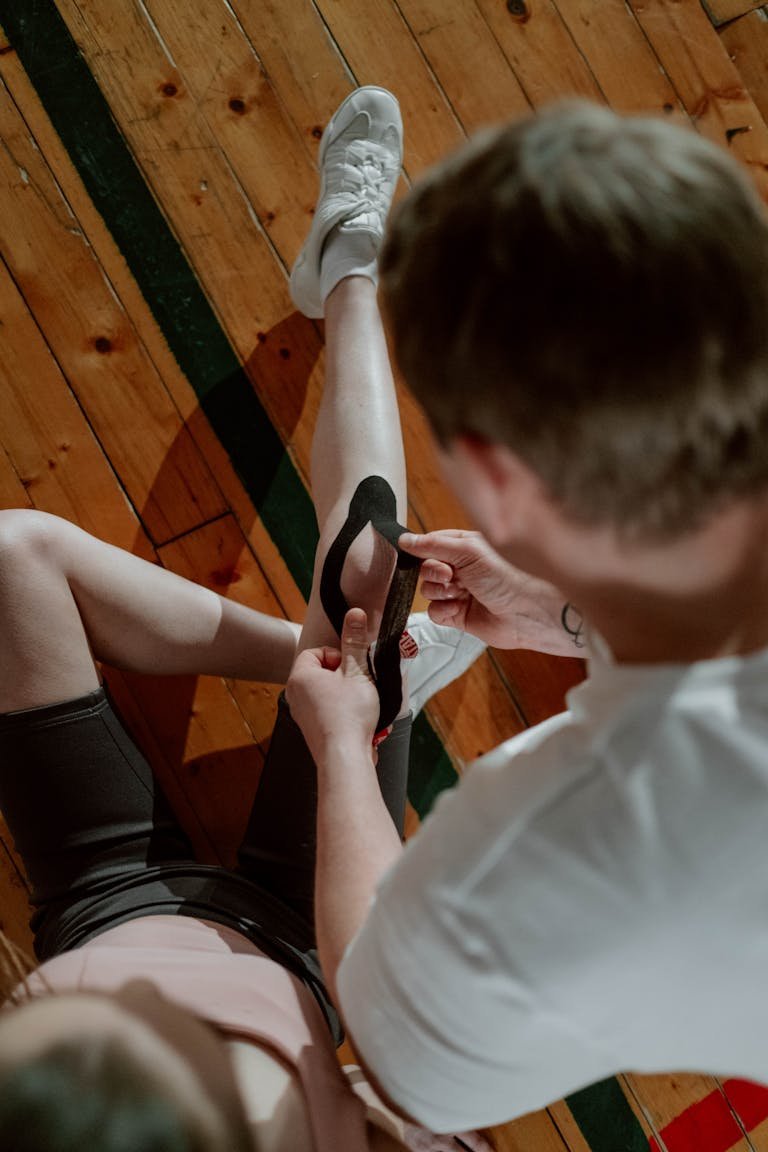
- Bracing and taping guidance if you’re returning after an injury.
No referral is needed.
Frequently Asked Questions About Exercises for Skiing
When should I start doing exercises for skiing?
Six to eight weeks before your first day on the hill is ideal. That gives your muscles and connective tissue enough time to adapt. Starting later still helps, and keeping up one or two sessions a week during the season maintains your gains.
Can I do exercises for skiing at home without equipment?
Yes. Wall sits, bodyweight squats, split squats, lateral lunges, single-leg balance, side planks and skater hops need nothing but floor space. A resistance band and a single dumbbell or kettlebell will let you progress further.
What muscles are most important for skiing?
Your quads, glutes and hamstrings do the heavy lifting, while your inner thighs, hip stabilizers and core keep you balanced and in control. Strong calves and mobile ankles also help you hold a good stance in ski boots.
Do exercises for skiing really help prevent injuries?
Training can’t remove all risk, but building strength, balance and landing control helps your body handle the forces skiing creates. Fatigue is a known contributor to injuries, so better conditioning means you stay sharper for longer.
Should I see a physiotherapist before ski season?
It’s worth it if you have a past injury, ongoing pain or a joint that “doesn’t feel right.” A pre-season assessment can identify weak links early and give you a program built around your body, not a generic template.